Conveyor crossovers with ship ladder installation
Categories: Industrial Stairs Distribution Centers, Packaging Food and Beverage Manufacturing Conveyor Crossovers & Access Manufacturing
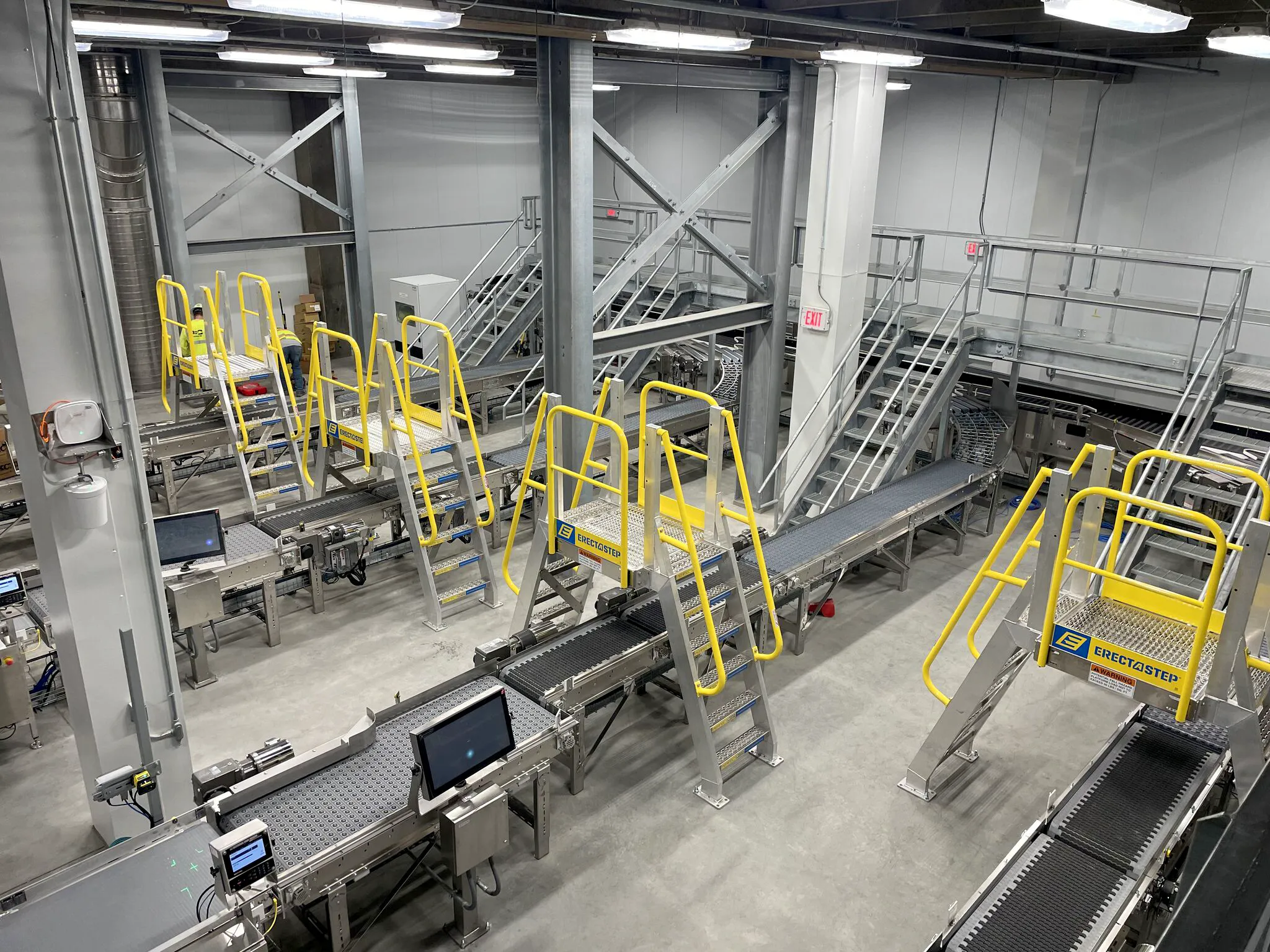
Four ErectaStep Ship-Ladder Crossovers Solve Conveyor Traffic in a Fulfillment Line
When a facility runs multiple parallel conveyor lines, operators need a safe, code-compliant way to cross from one side to the other without shutting down production, ducking under belts, or taking the long way around. This installation shows how four ErectaStep conveyor crossovers — each built with steep ship-ladder stairs — deliver exactly that.
The Application
The site is a packaging and sortation area with several parallel powered roller and belt conveyors running through the workspace. Scales, scanners, and touchscreen inspection stations line the conveyors, which means operators frequently need to move between stations on opposite sides of the belts.
Rather than route foot traffic around the ends of each conveyor — a costly detour that pulls workers away from their stations — the team specified four dedicated crossovers, positioned at the points where crossing traffic is heaviest.
Why Ship-Ladder Stairs
A traditional IBC stair rises at roughly 30 to 35 degrees and requires a substantial run of floor space on both the ascent and descent. In a tight conveyor aisle, that footprint simply isn't available.
Ship-ladder stairs (also called ships stairs) rise at a steeper angle — typically 50 to 70 degrees — which dramatically shortens the horizontal run. That lets the crossover tuck in close to the conveyor without blocking adjacent walkways, workstations, or the pedestal-mounted scanners and displays visible in the photo.
Key advantages of the ship-ladder configuration in this application:
- Compact footprint — the steeper rise keeps the stair tread run short so the crossover fits in narrow aisles between conveyors.
- Face-forward descent — unlike a vertical fixed industrial ladder, users walk down facing the steps, hands on the yellow handrails, which is faster and safer when workers cross frequently throughout a shift.
- OSHA-compliant — 24-inch-wide serrated treads, self-closing safety gates at each landing, and 42-inch handrails on both sides meet OSHA 1910.23 and 1910.28 requirements for walking-working surfaces and fall protection.
- Slip-resistant — the serrated aluminum tread pattern sheds debris and provides secure footing even when workers step off a conveyor line with residue on their soles.
Why ErectaStep Was the Right Fit
Four identical crossovers, delivered and installed on a live production floor, is exactly the kind of job ErectaStep's modular system is built for.
- Bolt-together modularity — each crossover is assembled from ErectaStep's five standard components: safety stairs, platforms, platform handrails, tower supports, and ladder units. No welding, no hot work permits, no downtime.
- Repeatable configuration — because all four units share the same span, height, and stair configuration, the customer gets a consistent user experience across the line and can standardize training, inspection, and maintenance.
- Fast lead time and install — pre-engineered aluminum components ship quickly and go together with hand tools, so the line was crossing-equipped in a fraction of the time a fabricated steel solution would have required.
- Aluminum construction — corrosion-resistant, roughly one-third the weight of steel, and never needs painting. Ideal for indoor facilities with wash-down zones, food and beverage handling, or humidity from adjacent processes. (See our comparison: aluminum vs. fiberglass.)
- Reconfigurable — if the conveyor layout changes, the crossovers can be unbolted, repositioned, or reconfigured to new heights and spans without scrapping the investment.
Similar Installations
- Nestlé Waters conveyor crossover — Ontario, CA
- Dual crossover stairs over a cement conveyor belt
- Ship ladder over a luggage conveyor — Denver International Airport
- Industrial metal crossover stairs installation
The Takeaway
Wherever conveyors, piping, machinery, or utility runs block foot traffic, an ErectaStep crossover with ship-ladder stairs is one of the fastest, most compact, and most cost-effective ways to restore safe passage. Four units in a single facility — like the installation shown here — demonstrate how the modular system scales cleanly across a production line without custom fabrication, welding, or extended downtime.
If your facility has a conveyor, pipe rack, or equipment run that workers are currently stepping over, ducking under, or walking around, ErectaStep can quote a crossover configuration in days, not months.