
Why Valve Height Matters
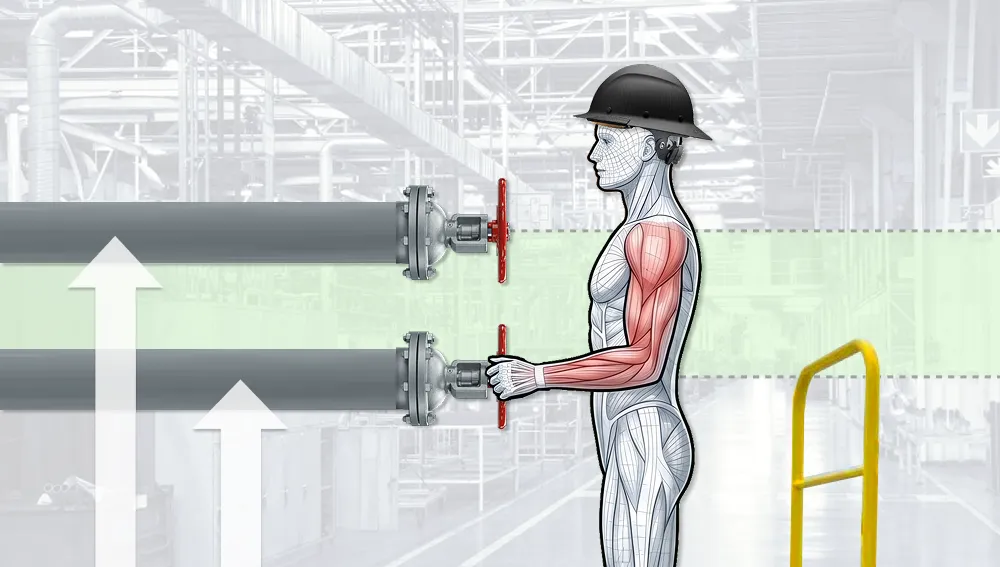
Valves are operated thousands of times across the life of a facility. Each turn of a handwheel or stroke of a lever applies torque through the operator’s shoulders, back, and trunk. When the valve handle is too low, too high, or beyond optimal reach, the operator compensates by bending, reaching overhead, or twisting — postures that increase musculoskeletal disorder (MSD) risk and reduce the torque the operator can safely apply.
A peer-reviewed ergonomics study published in Ergonomics found that workers exerted the greatest torque when valves were located overhead, but overhead operation places the shoulder and trunk in non-neutral postures, which are associated with elevated MSD risk. The study’s design recommendation was direct: “design engineers should avoid placing hand wheel valves at knee height or lower”1, and the risk to the shoulder and trunk is lowest when the valve sits at chest height, where postures remain near neutral.
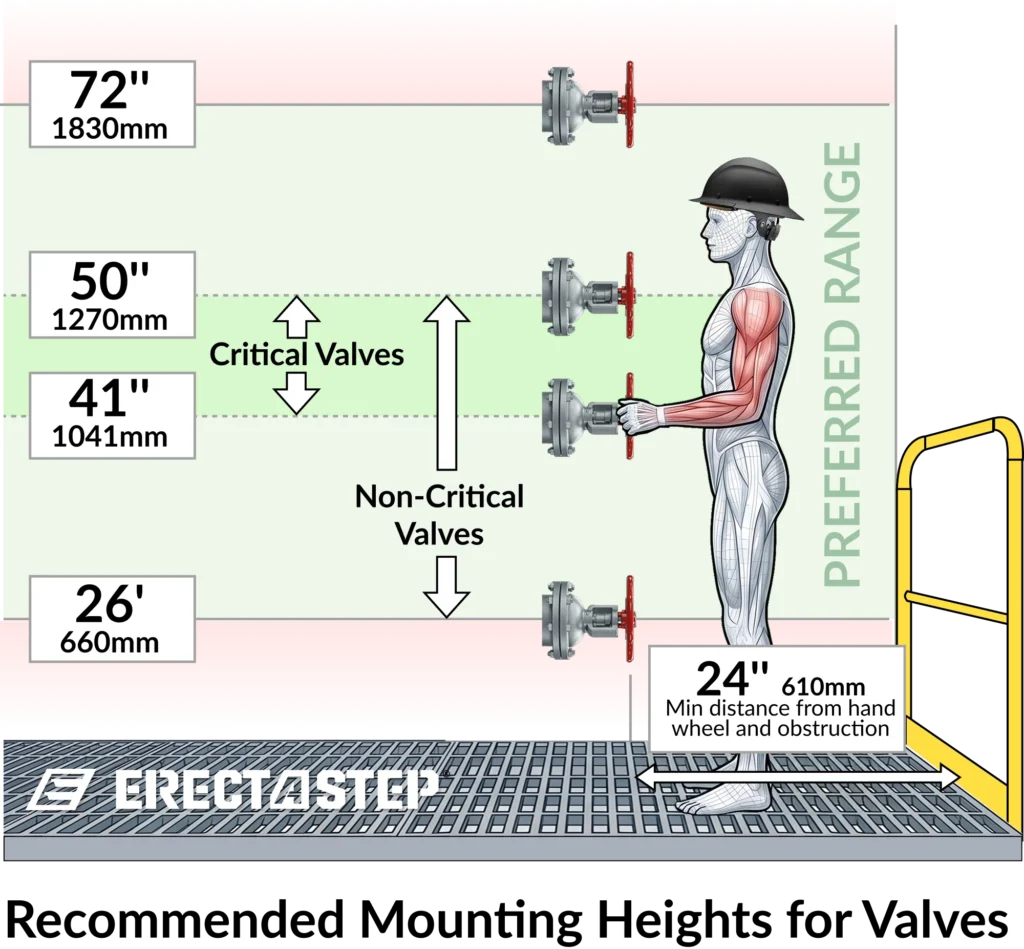
Recommended Mounting Heights — Horizontal Stem Valves
Getting the valve handle into the operator’s mid-body reach window is not a comfort preference. It is a safety control.
The chart below — based on operator design guidelines used across major pipeline and process operators — defines four reference elevations measured from the walking surface to the valve handwheel or lever centerline.
The Four Tiers
| Tier | Height (TOWS to valve centerline) | Application | Operator Posture |
|---|---|---|---|
| Preferred Centerline | 41″ | Optimal default for most horizontal stem valves | Waist height — neutral shoulders and trunk |
| First Choice | 50″ | Critical valves operated frequently or under emergency | Chest/shoulder height — maximum controlled torque with low MSD risk |
| Second Choice | 26″ | Non-critical valves, infrequent operation | Below waist — acceptable when overhead or bending alternatives are worse |
| Third Choice | 72″ | Avoid when feasible | Above shoulder — increases MSD risk, reduces controlled torque |
These ranges align with the operator-design ergonomic envelopes published in oil-and-gas valve mounting guidelines, which specify preferred handwheel and lever heights based on 5th–95th percentile operator anthropometry and call out unacceptable zones below 9″ or above 75″.
The 36″ TOWS Rule of Thumb
A practical field rule used by many pipeline and compressor-station designers: set the top of walking surface (TOWS) approximately 36″ below the valve centerline. This places the valve handle near the operator’s waist (≈41″), which falls within the preferred range and gives the operator a stable stance for applying torque.
When the valve is critical, raise the platform so the valve sits closer to chest/shoulder height (50″) instead of waist height. When the valve is non-critical and infrequent, the 26″ lower-tier elevation is acceptable.
Critical vs. Non-Critical Valves
- Critical valves — emergency shutdown valves, isolation valves operated under pressure, valves required during upset or fire conditions. Mount at the First Choice / 50″ elevation to maximize controlled torque and reduce time-to-actuate.
- Non-critical valves — drains, low-frequency isolation, valves that see scheduled-maintenance use only. The Second Choice / 26″ elevation is acceptable when geometry forces a trade-off.
Lever-Operated Valves
For lever-operated valves, operator design references generally recommend the lever end fall between roughly 24″ and 75″ above the walking surface, with no handle protruding into walkways when closed. The same TOWS logic applies: build the platform so the lever’s operating arc lands in the operator’s mid-body reach zone.
OSHA Compliance for the Access Platform Itself
Once you’ve identified the right valve elevation, the platform that gets the operator there must comply with OSHA 1910 Subpart D, Walking-Working Surfaces.
Key OSHA requirements that apply to valve access platforms and the stairs that serve them:
- Stairways — OSHA 1910.25: standard stairs installed between 30° and 50° from horizontal, maximum 9.5″ riser, minimum 9.5″ tread depth, minimum 22″ width, uniform riser/tread dimensions, and 6’8″ minimum vertical clearance above any tread.
- Fall protection — OSHA 1910.28: guardrails, stair rail systems, or other fall-protection on unprotected edges 4 feet or higher, including platform working surfaces around valves.
- Landings: stairway landings at least the width of the stair and a minimum of 30″ deep in the direction of travel.
- Load: stair components must support five times the anticipated live load, never less than a 1,000 lb concentrated load at any point.
For elevated valve work that involves entering vessels or pits, ANSI/ASSP Z117.1-2022 confined-space requirements may also apply — a separate consideration from the platform geometry itself, but one to factor into the access design.
ErectaStep — A Purpose-Built Solution for Valve Access
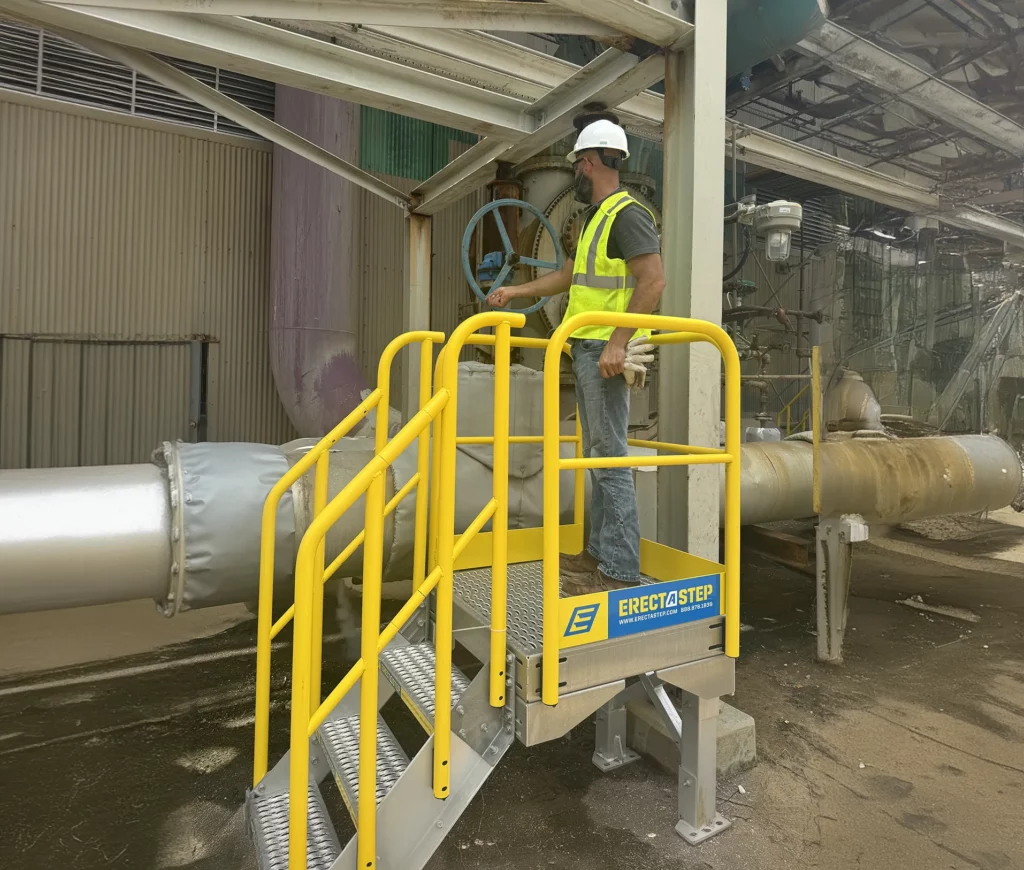
Valve access points are exactly the application for which ErectaStep was designed. Pipelines, compressor stations, tank farms, manifolds, and process skids all share the same problem: a valve is at an elevation beyond the operator’s reach, and the surrounding geometry is tight, congested, or otherwise hostile to the installation of fabricated solutions.
Why ErectaStep Fits Valve Access
- Five modular components, unlimited configurations. ErectaStep’s patented system uses just five core components that bolt together to create stairs, platforms, crossovers, and ladder-and-platform combinations. The same kit that solves a 36″-elevated valve also solves a 72″-elevated valve. (ErectaStep Industrial Stairs)
- In-stock and ready to ship. ErectaStep components are pre-engineered, in stock, and ship quickly. Standard configurations can ship in days, not weeks. (ErectaStep Resources)
- Pre-engineered for OSHA 1910 compliance. The full line of stairs and platforms is engineered to meet OSHA 1910.25 and 1910.28, with IBC-compliant options for public-access applications.
- Bolt-together — no welding, no hot-work permits, no shutdown. Components assemble on location with no custom tools, no on-site fabrication, no hot-work permits, and no production stoppage. This matters for compressor stations and tank farms where hot work creates permitting and safety burdens.
- Reconfigurable. When a tie-in changes or a valve is relocated, the platform is unbolted and reinstalled at the new location. The capital does not get stranded.
- Aluminum construction. Standard ErectaStep components are heavy-duty, corrosion-resistant aluminum — lightweight and maintenance-free. Galvanized and stainless steel options are available for specialized environments. (ErectaStep Made in USA)
- Slip-resistant walking surface. Stamped aluminum tread and platform surfaces provide aggressive slip resistance for operators carrying tools or PPE.
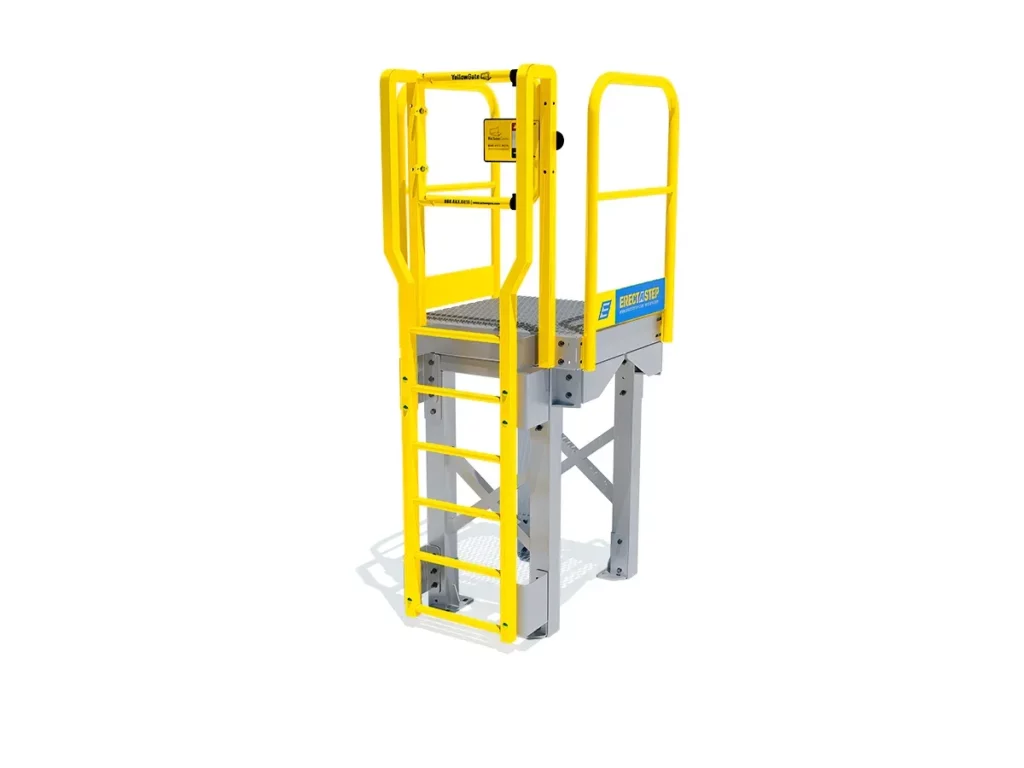
Configuring a Valve Access Platform
A typical valve access build follows a three-step logic:
- Identify the valve centerline elevation and decide the target tier (preferred 41″, first choice 50″ for critical, second choice 26″ for non-critical).
- Calculate TOWS by subtracting the operator reach offset (typically ~36″ for waist-height operation).
- Specify the ErectaStep configuration — stair run, platform footprint, handrail, toeboard, and gate — using the standard 9″ rise / 9.5″ run stair module and 3′ x 3′ platform modules. Custom platform sizes and embankment configurations are available for non-standard geometry.
A Comprehensive Safety and Access Suite
ErectaStep, RollaStep, and YellowGate together cover the full spectrum of access and fall-protection needs around valve installations:
- ErectaStep — fixed modular stairs, work platforms, crossovers, ladders, and pipe/valve access platforms.
- RollaStep — mobile rolling stairs and rolling work platforms for valve banks that are inspected from multiple positions or that require temporary access during turnarounds.
- YellowGate — universal self-closing safety gates and barrier systems to protect ladder openings, mezzanine edges, and platform access points around the valve work area.
Frequently Asked Questions
For most horizontal stem valves, the preferred valve centerline is approximately 41 inches above the top of walking surface (TOWS). For critical valves, 50 inches (chest/shoulder height) is the first choice. For non-critical, infrequently operated valves, 26 inches (below waist) is acceptable. Heights at or above 72 inches should be avoided when feasible.
A widely used field rule is to set the top of walking surface approximately 36 inches below the valve centerline. This places the valve handle near the operator’s waist, within the preferred ergonomic range and supporting controlled torque application.
Research published on PubMed shows that while operators can exert greater peak torque on overhead valves, doing so places the shoulder and trunk in non-neutral postures that elevate musculoskeletal-disorder risk. Mounting the valve at chest height keeps postures near neutral and reduces injury risk over the life of the facility.
Because ErectaStep components are in-stock, pre-engineered, and bolt together with no welding, most standard configurations ship in days and install in hours to days — without hot-work permits, on-site fabrication, or production shutdowns.
Yes. ErectaStep’s bolt-together design lets the platform be disassembled and reinstalled at a new location. The capital follows the asset rather than getting stranded with a welded structure.
Yes. ErectaStep is widely deployed for valve access on pipelines, compressor stations, tank farms, manifolds, and process skids. The aluminum construction is corrosion-resistant for outdoor and coastal environments, and galvanized and stainless steel options are available for specialty applications.
- Wieszczyk SM, Marklin RW, Sánchez HJ. Height of industrial hand wheel valves affects torque exertion. Hum Factors. 2009 Aug;51(4):487-96. doi: 10.1177/0018720809340780. PMID: 19899359.